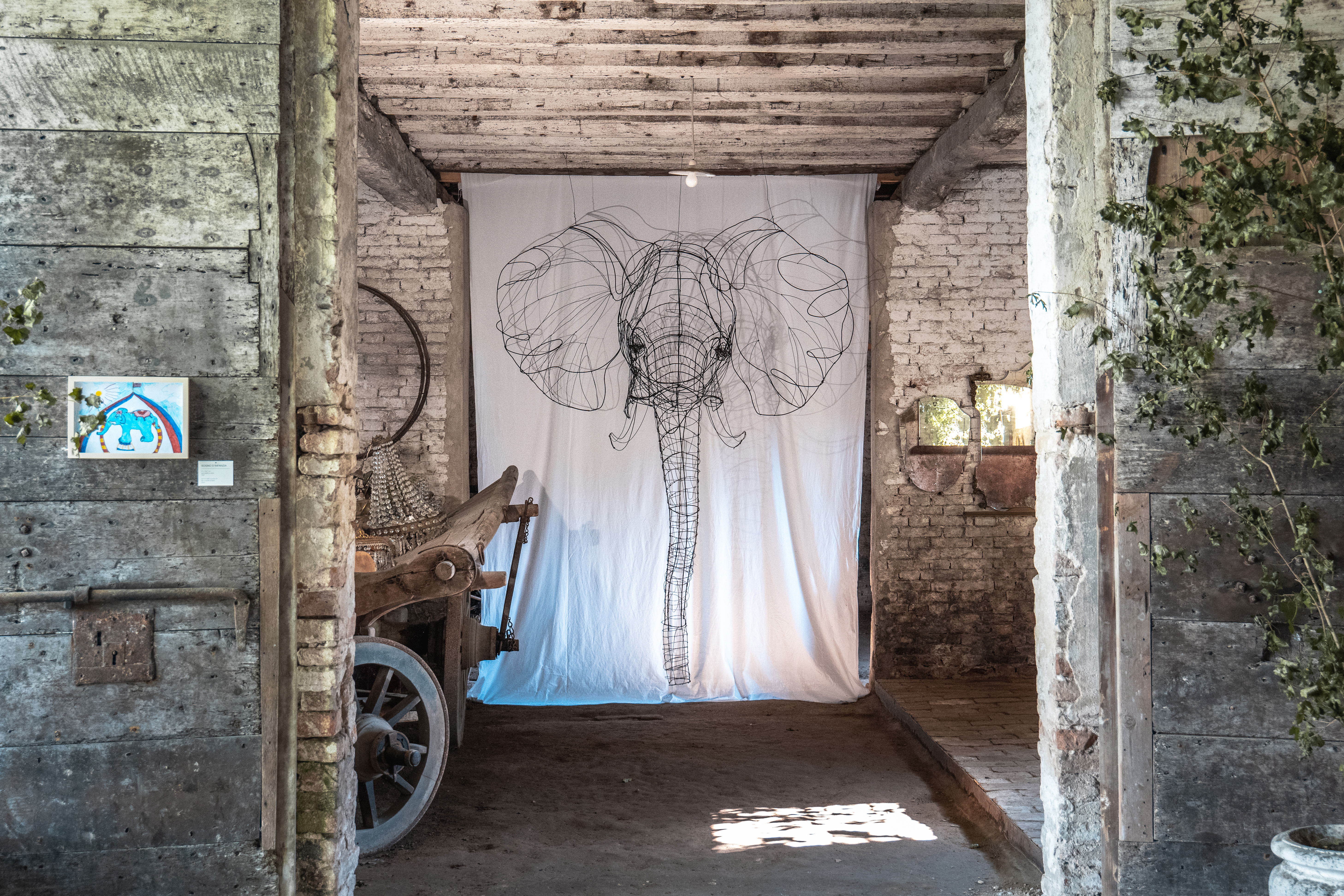
The sculptor has listened to the shadows of his drawings, questioned the slender and subtle elephant heads and has gone elsewhere, taking with him all the wonder and inner strength of that lightness.


Glamping Canonici di
San Marco, Mirano,
Venezia
The sculptor has listened to the shadows of his drawings, questioned the slender and subtle elephant heads and has gone elsewhere, taking with him all the wonder and inner strength of that lightness.
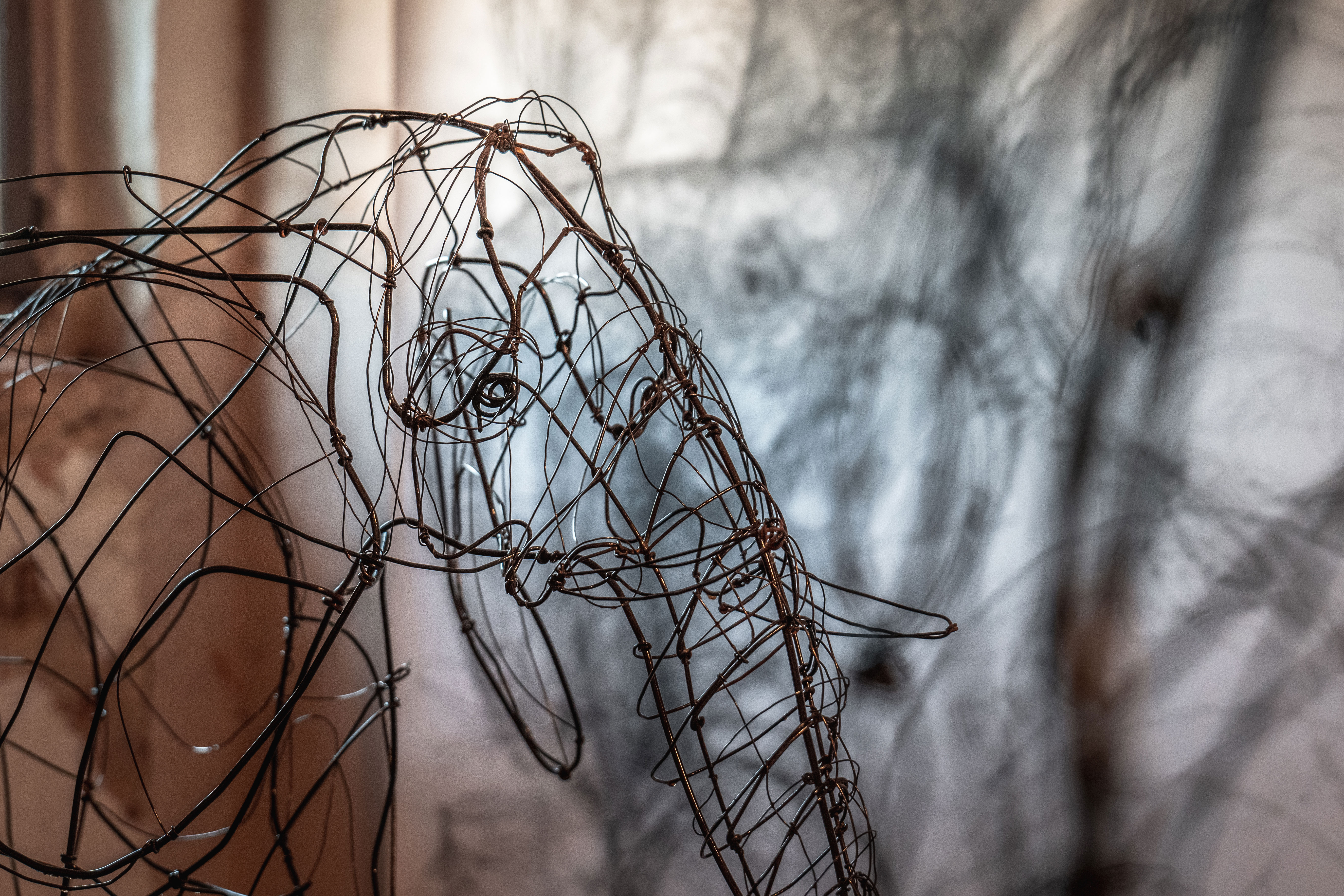
The artist’s work, said Proust, consists in the perpetual transformation of the things being represented, analogous to the role of the metaphor in poetry.
His words came to mind when considering the work of Giovanni Pinosio, who, clearly starting from a highly personal figurative culture, knew to await the moment when rough forms take shape from the
metal wire, his artistic language of choice, and move towards new material experiments.
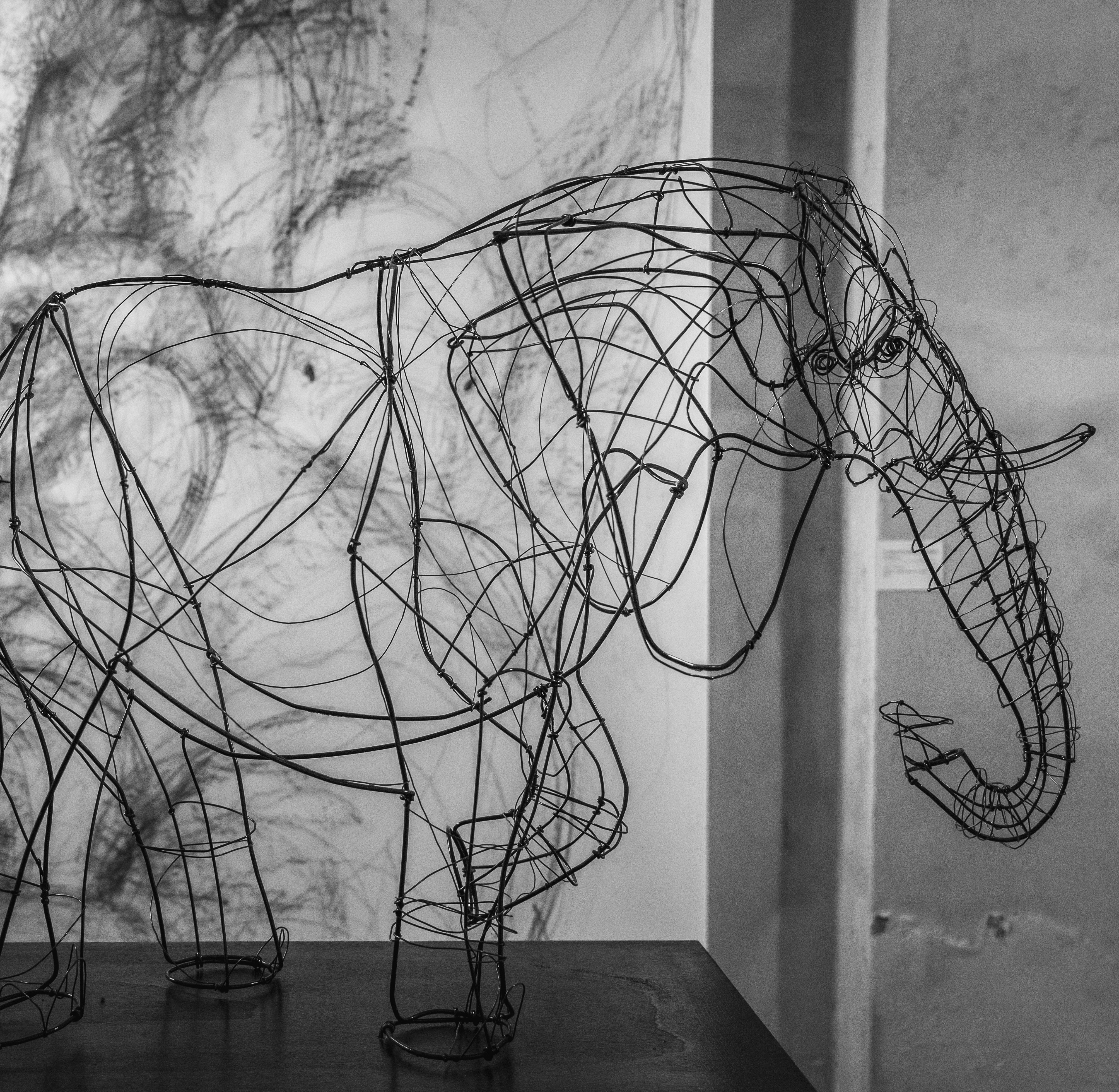
Pinosio has created animals before and, in recent years, has often perceived their apparition and proximity. This left such a powerful impression on him that it pushed him, once again, to draw the
elephant, his new alter-ego, to understand it better and discover its hidden message.
He met the initial challenges of this artistic journey between the four walls of his living room at home.
Indeed, his early visions of the animal, in a full and direct dialogue with totemism – an area of great interest for the sculptor – came from a vivid dream and formed the basis for his work.
As Pinosio describes it: "Their size freed my hand, their sociability suggested the intermeshing of numerous marks and lines. Their acute hearing amplified by inner listening. For me, drawing is a
profound act of understanding, external and internal. It is the expression of a gesture, it is meditation.”
So, as his graphite and charcoal lines gradually became more meticulous, the walls seeming to disappear and their boundaries blur, Giovanni's eyes opened wide and lit up.
In the first room, the journey catalyses one's gaze, is already compelling, and ideas take shape, connections become clear. It’s self-evident that none of the works in this collection lead the observer to
believe anything pre-existed before these were under way.
Pinosio didn't start from a fixed design: his elsewhere is a concrete interior place that materialised from lines that, little by little, diverged from the only viable (tangible) one, paradoxically when the body and the participant's presence were well-established.
It’s a path marked by reflection.
So here is the lattice of shadows on which the main apparition rests: the elephant’s tracks, light yet significant just like its footsteps. A familiar yet at the same time enigmatic presence, where the magical component alternates in passing from the substance of the metal to the spaces in-between; in the unexpected unfurling of a line from within the ball of wire, captured by an expansive gesture, finally free of academic constrictions.
It all contributes towards enriching and refining his lexicon, with patience and a focus on the organic nature of the environment from which it emerges: the large black drawings in dense tangled mesh, redolent of the night of alchemy, or the Archipelagos entwined in a web of maps, all from Pinosio's imagination.
Its roots, in the pursuit of this journey, are buried in the connection with both the story and authentic experiences of the artist. They provide stability and nutrition, while his curiosity for the outside world grows. We learn that the elephant, an "exotic” animal from faraway places, passed through the artist's childhood and has already accompanied him towards his Elsewhere.
The ability to be flexible and open to what his unconscious allows him to explore is central and decisive.
The exhibition proceeds vertically, like an internal impulse that binds it to the recesses of its purest self, and also horizontally, revealing the interaction with the outside world, the playful and renewed gaze.
It's clear that the deus ex machina of this duality is once again time, a theme dear to Pinosio, which demands his total physical and mental commitment. That’s why each work is not only an end point, but also the beginning of a new phase. Points that, put together, form a clear trajectory.
The sculptor skilfully studies the rules that underpin the vastness of Nature and he questions them, elegantly and powerfully. The protagonist of his childhood dream does not, surprisingly, invade the space but, on the contrary, has a subtlety that chimes with the empty space around it, awaiting the definition of its form.
Leaving its breath, its weight, to pass through it.
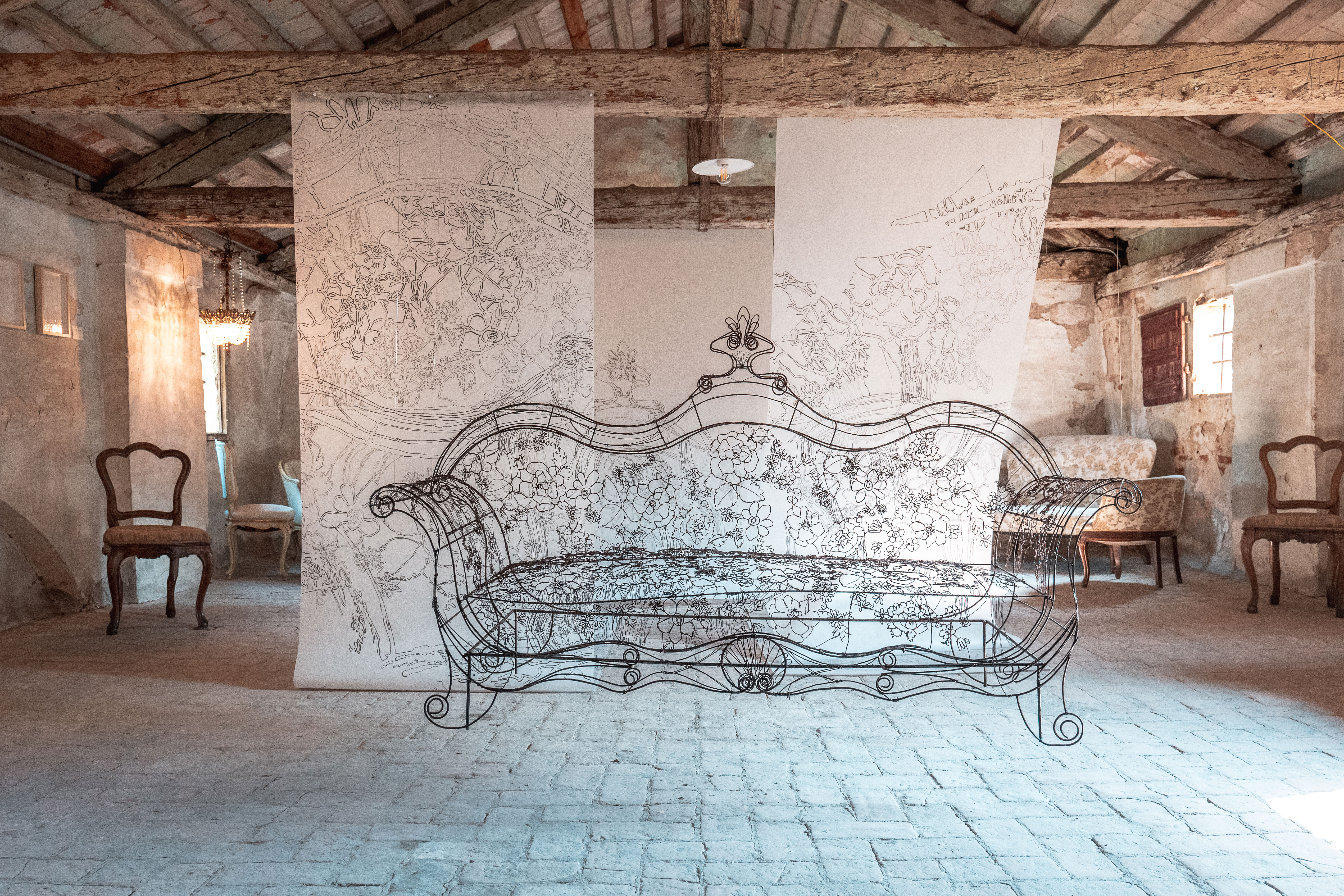
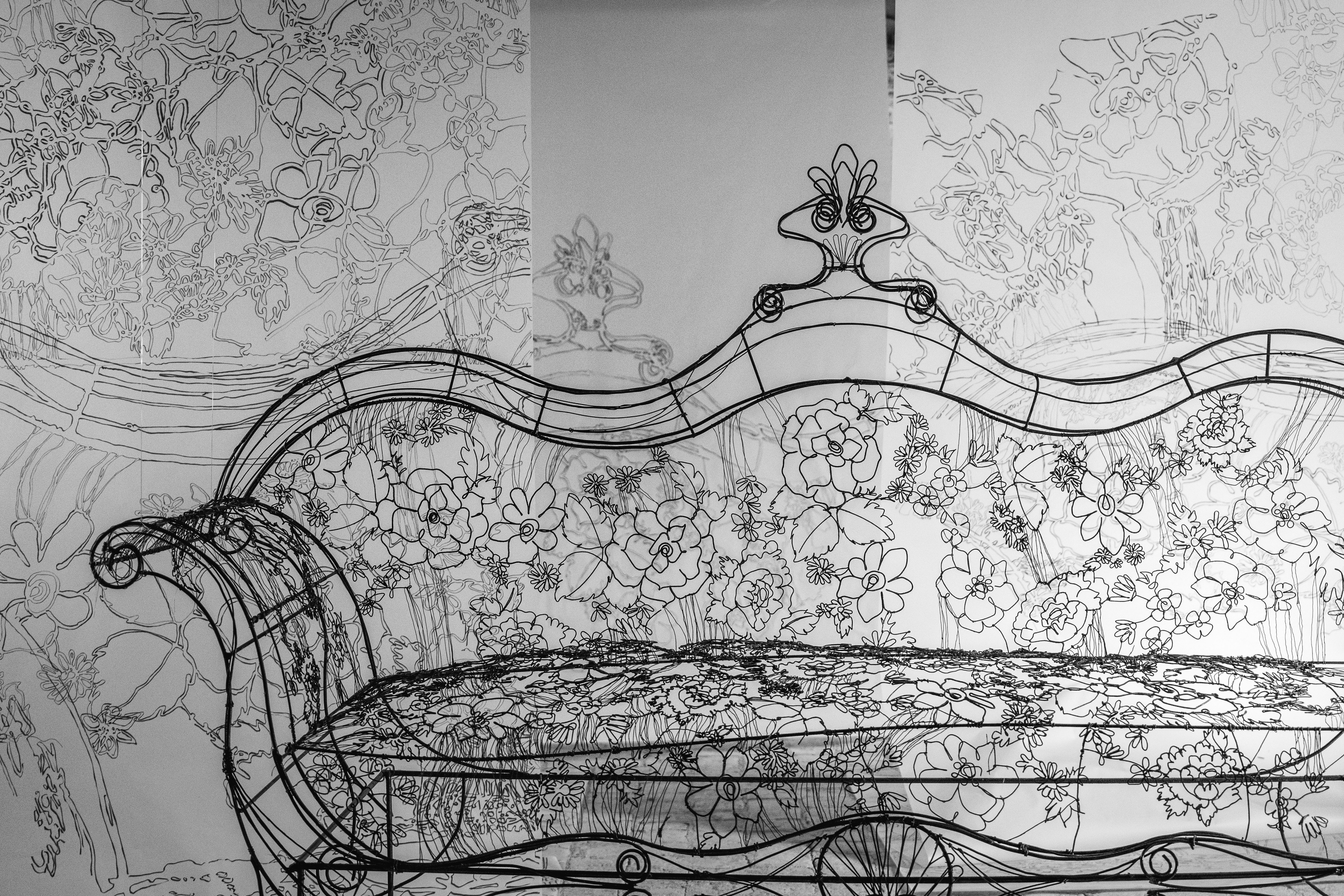
To mark the way, then, we come to a kind of room in suspension, a snapshot of a pause (or a memory?) observed with affection and wonder: a sofa raised off the ground, a workshop where everything seems to have been left unaltered, in medias res. What is in potential motion before us? Floral patterns and sculptures now pulsate like an expanded dimension that sings within us, with shadows that echo them in different directions.
And there's more, the paper embroidery and wall hangings, from tracing shadows to three-dimensionality, these two are new sculptures; only the appearance changes.
It's the place where aspirations, dreams and fears converge, ones that also exist in the real world, but that the unconscious transcends, leaving them to exit the room of their own accord.
In conclusion, at his calm and interminable pace, Pinosio shows the signs of a maturity where all logic has apparently vanished and immediacy has transformed even gravity. With this enormous range of subject matters, it makes you smile how, as someone said, a line has literally gone for a walk.
The sculptor has listened to the shadows of his drawings, questioned the slender and subtle elephant heads and has gone elsewhere, taking with him all the wonder and inner strength of that lightness.
Antonella Argentile